

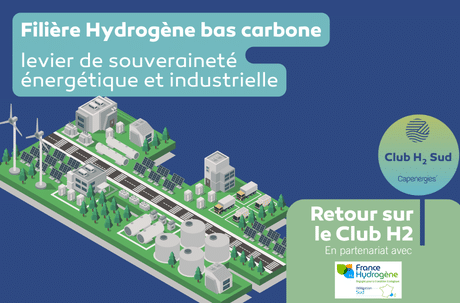
A look back at the Club H2 Sud event, organised in partnership with the Southern France Hydrogen Delegation – 19 May 2026
Low-carbon hydrogen has now entered a new phase: that of scaling up to industrial levels.
Globally, competition is intensifying. China produced nearly one million tonnes of low-carbon hydrogen in 2025 and is stepping up its investment in electrolysers, infrastructure and industrial applications. The United States is continuing to roll out its strategy under the Inflation Reduction Act, whilst Europe is seeking to establish a competitive market based on its Green Deal, the «Fit for 55» package and its REPowerEU targets.
In France, the revision of the Multi-Annual Energy Plan (PPE3) and the update to the National Hydrogen Strategy must now be translated into funded and implemented industrial projects.
For behind the climate targets, one reality stands out: low-carbon hydrogen has become a key issue for energy security, industrial competitiveness and the reindustrialisation of regions.
It is with this in mind that Capenergies and France Hydrogène brought together stakeholders from the sector for a day of discussions focused on the prospects for the development of low-carbon hydrogen in France.
A sector currently undergoing restructuring
At the start of the meeting, representatives from France Hydrogène provided an overview of the sector and the main projects currently underway.
The discussions focused on the institutional and regulatory developments that are currently shaping the sector’s development: the relationship between the Multi-Annual Energy Programme (PPE3) and the future National Hydrogen Strategy, national priorities, changes to support schemes and the key issues driving industry engagement.
A clear message has emerged: following an initial launch phase driven by public policy, the sector is now entering a phase in which the economic viability of projects and their ability to integrate into comprehensive value chains are becoming crucial.
Regions at the heart of hydrogen development
The roll-out of low-carbon hydrogen also relies on strong regional momentum.
During a discussion focusing on Capenergies’ regional initiatives, it was emphasised that local areas are the real hubs for the roll-out of hydrogen ecosystems.
Production, transport, storage, industrial applications, mobility and the integration of renewable energy: the sector’s development requires a coordinated approach involving local authorities, manufacturers, energy companies, research centres and funders.
Industrial markets taking action
Whilst the sector continues to take shape, several markets already have projects at a particularly advanced stage.
The speakers presented three industrial applications illustrating the wide range of uses for low-carbon hydrogen.
In the refining sector, ENGIE discussed the HyGreen project, which aims to gradually replace fossil hydrogen with low-carbon hydrogen.
For the aviation sector, MGH Energy presented the L’Ardoise project, which focuses on the production of sustainable aviation fuels (e-SAF), a market set to play a major role in the decarbonisation of aviation.
And finally.., GravitHy shared his insights on the production of pre-reduced iron (DRI/HBI), highlighting the potential of hydrogen to decarbonise the steel industry, one of the sectors with the highest CO₂ emissions₂.
These three examples show that hydrogen is no longer an experimental technology: it is now being used in practical industrial applications across several strategic sectors.
Technological innovation remains a key factor
The sector’s ability to scale up also depends on technological progress.
Through a presentation focusing on electrolysis technologies, Air Liquide discussed the innovations that can improve equipment performance, reduce production costs and boost the competitiveness of low-carbon hydrogen.
The industrialisation of electrolysers is now one of the key drivers for achieving Europe’s targets for renewable and low-carbon hydrogen production.
Building a competitive and self-sufficient sector
Beyond the various presentations, the day served as a reminder that the challenges surrounding hydrogen now extend beyond the context of the energy transition alone.
Developing an efficient hydrogen sector also means strengthening energy sovereignty, securing industrial supplies, creating new value chains and contributing to the reindustrialisation of regions.
In the face of intensifying international competition, the success of this ambition will depend on the ability to coordinate public policy, innovation, industrial investment and cooperation between stakeholders in the sector.
By bringing together businesses, institutional stakeholders, experts and project leaders, Capenergies and France Hydrogène are contributing to this collective drive by fostering dialogue, the sharing of experiences and the development of collaborations that will help accelerate the roll-out of low-carbon hydrogen.
Thank you to all the speakers and participants for the fruitful discussions that enriched this meeting.
See you at the next Club H2 Sud event on 17 November 2026
Find out more at:

Pierre CECCALDI
Hydrogen and Bioenergy Project Engineer – H2MOVE
pierre.ceccaldi@capenergies.fr
+33 7 70 19 20 31