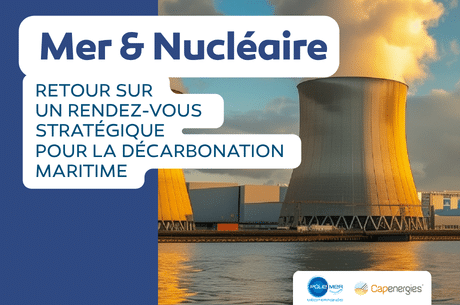
An unprecedented combination of players, technologies and challenges
On 12 February, over 90 key players from the South of France met to discuss the challenges of decarbonising maritime activities, with a focus on innovative solutions for decarbonising activities at sea in the broadest sense (maritime transport, port infrastructures, etc.), at the initiative of Capenergies and the Maritime cluster.
The role and challenges of nuclear power in the maritime sector's energy transition
Decarbonising maritime transport: one of the most difficult sectors to decarbonise
Maritime transport is responsible for around 3% of global CO₂ emissions in 2022 (Source IPCC), a figure that is set to rise sharply given the increase in traffic and volumes of goods transported. In fact, more than 80 % of the volume of goods traded worldwide are transported by sea - making it the main mode of transport for international trade (Source UNCTAD). Combining nuclear energy and new low-carbon technologies to reduce these emissions is a novel and strategic approach.
On this subject, the New Energy Coalitioninitiated by CMA CGM (a consortium of key players in international supply chains aiming to develop innovative technologies and energy solutions to decarbonise maritime, air and road activities worldwide), presented the challenges and opportunities linked to the sector's energy transition, highlighting large-scale low-carbon solutions: transformation of the sector (SmartShips, biofuels and e-carfuels, on-board carbon system, etc.), the development of new technologies and the development of new energy sources.
On-board nuclear power: unique expertise
On-board nuclear power for ship propulsion or on-board energy production is underdeveloped worldwide. TechnicAtome shared its unique, world-renowned expertise in onboard nuclear power, opening up concrete prospects for the maritime sector, where safety, regulation and technical innovation are key issues.
Adapted infrastructures: Synergies between industrial and port players
Naval Group detailed the challenges involved in adapting port facilities to these new technologies, because to decarbonise the sector, all levers are essential. On the port side, investment in electric terminals and alternative fuel refuelling infrastructures, the electrification of quays, automated mooring systems, optimised flows and logistics, etc. were all mentioned.
Territorial projects and regulatory framework
Discussions also focused on port and nuclear regulatory constraints and opportunities, a cocktail rarely covered in the same forum.
Structural initiatives such as Syrius in Fos-sur-Mer exist and have been presented. This large-scale programme is the result of a collective, cross-sector approach that Capenergies is co-leading, with the ambition of reducing industry's greenhouse gas emissions by almost 80 % by 2050. The challenge is initially to identify and characterise several decarbonisation levers and to support industrial companies in these projects in order to achieve the decarbonisation objectives within our study area (Fos, Berre periphery, Gardanne Meyreuil).
Concrete exchanges and identified opportunities
In addition to the speeches, the meeting was marked by the richness of the exchanges between participants from the maritime and nuclear sectors, which continued beyond the event. The networking sessions encouraged concrete discussions between players with complementary expertise.
Organised in partnership with the Pôle Mer Méditerranée, the event provided an opportunity to compare approaches and identify areas of convergence between the two ecosystems, particularly around the challenges of decarbonising offshore activities.
These discussions have helped to identify the initial avenues for collaboration, illustrating the value of this type of format at the interface of several sectors.
>> NEXT NUCLEAR CLUB ON 18 JUNE + INFO :
Julien FLUZIN
Project Engineer - Decarbonisation of Industry, Nuclear Energy Julien.fluzin@capenergies.fr
+33 7 87 70 12 88
Important information
Misuse of our company name
Our company has been informed that automated telephone calls are being made by third parties using our brand name improperly.
Please note that these calls are not issued, sponsored or authorised by Capenergies. We are therefore not the source of these calls and accept no responsibility for them.
This constitutes fraudulent use of our name without our consent.
We invite those concerned not to communicate any personal information and to report unwanted calls to the relevant platforms.