
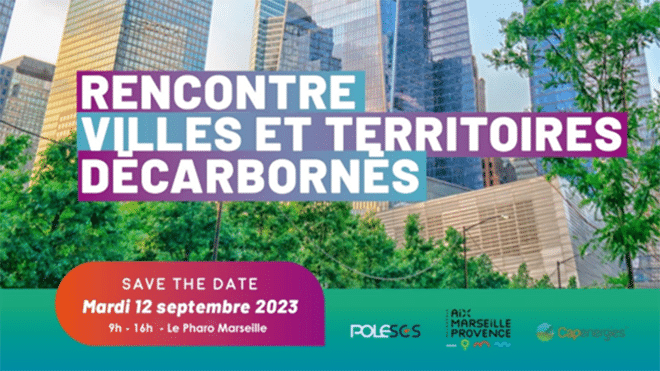
The day, which focused on emerging technological innovations (from SCS & Capenergies) capable of meeting the challenges of sustainable, low-carbon cities and territories, was a great success.
Each of the players taking part in the round table (metropolitan authorities, water operators and distributors, energy suppliers, a training school on the building of the future, etc.), as well as digital and low-carbon energy start-ups, recalled the following points 2 major points :
- DIGITAL SOBRIETY and the importance of a coherent deployment of sensors, giving priority to tools already in place,
- the importance of PARTNERSHIP INNOVATION between local authorities, digital and energy players,
For Olivier Chavrier, Managing Director SCS : " SCS technology solution providers not only need to make themselves known to Capenergies' low-carbon solution providers, decarbonisation and smart building professionals, and local authorities in charge of urban decarbonisation in their areas, but also to understand the various issues and regulations currently in force. In this way, they will be able to become acculturated, develop their technological offerings, and experiment with use cases that respond to the problems of decarbonised cities, to ensure that they are well suited to the needs of this complex, highly regulated but buoyant market".
For Anne-Marie Perez, Managing Director of Capenergies : "Capenergies has been supporting projects to decarbonise cities and regions for a number of years (e.g. the IRIS and InterConnect projects). These projects are increasingly integrating digital technologies, as they are powerful tools for decarbonisation in different sectors: building, industry, mobility, etc. These technologies enable more data to be processed efficiently, problems to be identified more quickly and innovative solutions to be tested virtually. The synergy between the energy and sober digital ecosystems is therefore highly beneficial in terms of the challenges of the ecological transition, and this meeting is an opportunity to bring key players together around the table, to discover new local use cases and their feedback".


As stated in Marie-Christine Bouillet of Métropole Aix-Marseille-Provence "We're taking a global approach to urban environmental monitoring. We only install sensors if there is a need for them, and then we test the data feedback to make sure it is efficient".

When it comes to preserving resources, initiatives abound at the Canal de Provence. " Our approach is one of open innovation... We rarely innovate alone! " intervenes Clément Diot, Head of Innovation at Société du Canal de Provence.
Against a backdrop of rising electricity prices, EDF is facing the same problem. Three questions are at the heart of our concerns: what resources do we have to produce the energy we need so badly? How can we rationalise consumption? Are the means of production in place carbon-free?

And as Gérald Cotinaut, Regional Director for Development and Territories at EDF MéditerranéeThe number of use cases is increasing. With Dalkia, the town of Sète has set up a smart management system for urban lighting.
Another topic under discussion: collective self-consumption. To put it plainly, this involves decarbonising by creating a renewable energy community: a producer and consumers of energy share the energy produced locally. In Alès, for example, the le Soleil de Rochebelle" development benefits from energy produced by photovoltaic panels.

David Simplot, Digital Deputy for the town of Antibesshares its experience of using IoT, which "It's a way of linking the physical and virtual worlds, in particular in favour of "smart water management. Sensors are used to anticipate and detect water leaks in the networks in real time (estimated at 20% of loss). The quality of bathing water is also monitored: a mesh network of intelligent sensors detects any deterioration in bathing water.

The intervention ofAnne-Sophie Kerninon, Head of the SME, Sourcing and Innovation Office at the State Purchasing DepartmentThe event was an opportunity for the companies present to find out about the procedures and tools dedicated to innovation (such as the APProche portal and the Place platform).
Juliette Fropier, Artificial Intelligence project manager at Ecolab (General Commission for Sustainable Development) presented the call for projects "Frugal AI demonstrators for the ecological transition in territories", an opportunity to test innovative solutions in real conditions and on a representative scale.
Valentina Vologni, Project Engineer at Capenergieshas relayed an innovation opportunity for start-ups, VSEs and small businesses.
SMEs in the region: the Med'Innovant competition run by the EPA EuroMéditerranée.
5 start-ups were also given the opportunity to to promote their solutions:
➢ FleetEnergies
develops a platform for decarbonising logistics
➢ Aiway presents a remote sensing solution for irrigation
➢ Ubigreen provides a data-driven solution for optimising building performance
➢ SerenySun offers support for collective solar self-consumption projects and a B-to-Territory business model
➢ NepTech
designs low-carbon naval mobility solutions
The day continued with a
buffet followed by 73 meetings between speakers and participants.
